In a quote you shared
Silence in the face of evil is itself evil.
It sounds like him, and it is everywhere. The general editor of his collected works in English says it doesn't appear anywhere in his writings.
The Costly Grace Companion · In Dietrich Bonhoeffer's own words
Cheap grace and costly grace, Karl Barth, the letters from prison, and Life Together, read in Bonhoeffer's own words beside serious scholarship, with the famous stories and quotations checked.
“Forgiveness that asks nothing and changes nothing. ‘Cheap grace means the justification of sin without the justification of the sinner.’”
Does this sound familiar?
Silence in the face of evil is itself evil.
It sounds like him, and it is everywhere. The general editor of his collected works in English says it doesn't appear anywhere in his writings.
That church preaches cheap grace.
The phrase is his. But he aimed it first at his own church, and in the same book he forbade using discipleship to attack others.
Bonhoeffer would be on our side.
Every side claims him. Few have read the prison letters, or the page where he tells disciples to love their political adversaries.
You don't need another Bonhoeffer poster. You need what he actually wrote, where scholars disagree, and the honesty to say which stories are not documented.
What's at stake
Warren Throckmorton found the famous "silence" sentences attributed to Bonhoeffer in a 1998 museum newsletter, and nowhere earlier. Repeating them puts words in a martyr's mouth.
Bonhoeffer wrote that "it is faith which justifies, and not the act of obedience." Read without that line, the book produces anxious or harsh Christians.
In the same letters he read the Bible morning and evening, sang hymns, and proposed a "secret discipline" to guard the church's mysteries.
Scholars warn against using his story to name a "symbolic Nazi." He carried no bomb, and his book tells disciples to love "political" adversaries.
A different way to read him
In April 1944, in a prison cell in Berlin, Bonhoeffer wrote to his closest friend about the question that would not leave him alone.
The kit is built on that question. Each core reads one of his answers: Christ as the Word, as the one who calls, in a disciple's life, in the letters from prison, and in the church. Every topic asks what he actually wrote, what scholars say, and where the kit's reading stops.
What is bothering me incessantly is the question what Christianity really is, or indeed who Christ really is, for us today.
Try it now
These answers are copied word for word from the Quick-Answer Index. In the kit, each one takes you to the page where it is explained with its sources.
“Someone posted the ‘silence in the face of evil’ quote”
Answer
The sentence has not been found in his writings; Barnett said it "doesn't appear anywhere." Quote "After Ten Years" instead.
The index covers 48 situations like these.
The kit's method
The framework, the question Bonhoeffer asked from prison, is the kit's own way of ordering his writings. Every paragraph is also labeled as documented fact, interpretation, or opinion.
His words from named English editions, with letter dates, each quotation checked word for word before layout.
All five coresMarsh, DeJonge, Barnett, Larsen, and others, including where they disagree, with the museum's record of his life.
All five coresApplications are marked as interpretation or opinion, disputes are left open, and no present-day party is named as Nazi.
Cores 3, 4, and 5Bonhoeffer asks the question himself, and answers that the words are “the consolation for one whose attempts to follow Christ had taught him that he can never become sinless.” Taken as a premise, they justify sin. Taken as Luther's last word to a troubled disciple, they testify “to the costliness of grace.”
Documented factBonhoeffer quotes Luther: “Pecca fortiter, sed fortius fide et gaude in Christo (‘Sin boldly, but believe and rejoice in Christ more boldly still’).”
Documented factHe explains that for Luther “sin boldly” “could only be his very last refuge, the consolation for one whose attempts to follow Christ had taught him that he can never become sinless.”
Documented factHe concludes: “Interpreted in this way, these words of Luther become a testimony to the costliness of grace, the only genuine kind of grace there is.”
OpinionWhether a word of comfort heals or harms depends on who hears it. “Sin boldly” is medicine for the conscience that is crushed, and poison for the conscience that is careless.
Source: Dietrich Bonhoeffer, The Cost of Discipleship, trans. R. H. Fuller, rev. Irmgard Booth (SCM Press, 1959), with the full reference in the Core 2 sources.
Anatomy of an item
The short answerThe essentials in a few lines, ready when you need them.
Every paragraph labeledDocumented fact, interpretation, or opinion: you always know which is which.
His own words, in contextThe sentence around the famous phrase, so no line is quoted against its meaning.
What to do with itA recommendation, labeled as opinion, so you can weigh it.
The sourceEvery quotation checked word for word, with the edition named.
What's inside
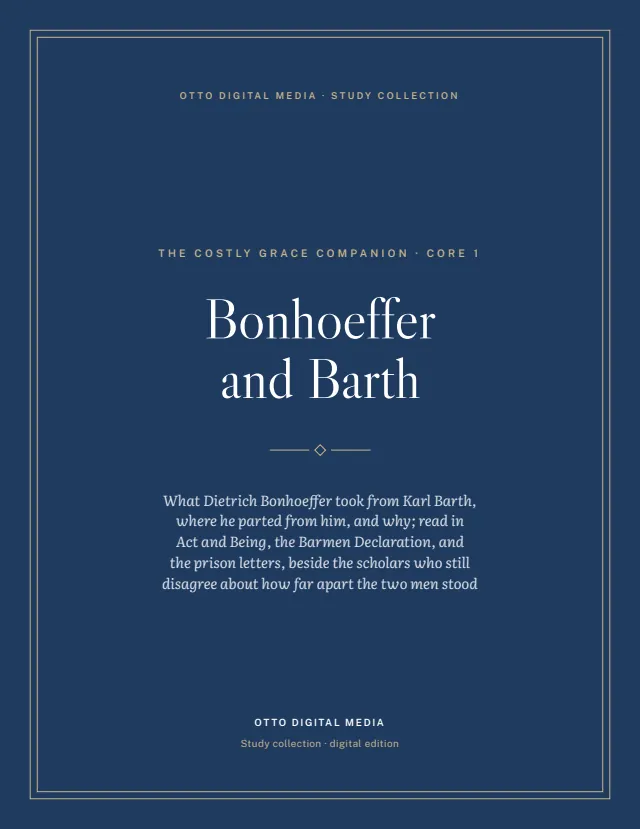
Core 143 pages
The friendship, the Barmen Declaration, Act and Being, the prison charge of "positivism of revelation," and the Lutheran roots
Core 240 pages
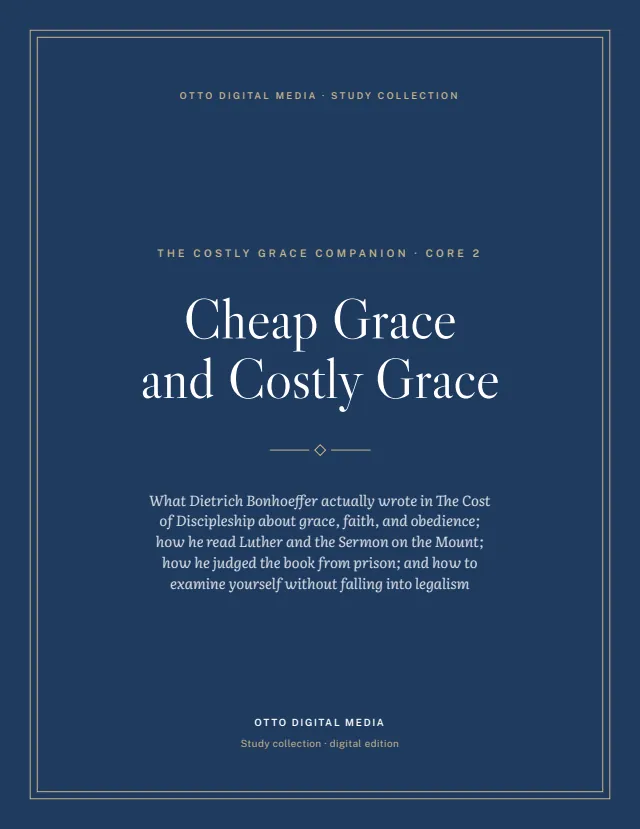
His definitions, Peter and Luther, faith and obedience, the Sermon on the Mount, and what he said about the book from prison
Core 341 pages
From Breslau to Flossenbürg in the museum's record and Marsh's biography, and seven popular claims checked
Core 440 pages
The letters to Bethge on religion, God at the centre, the suffering God, and "the man for others"
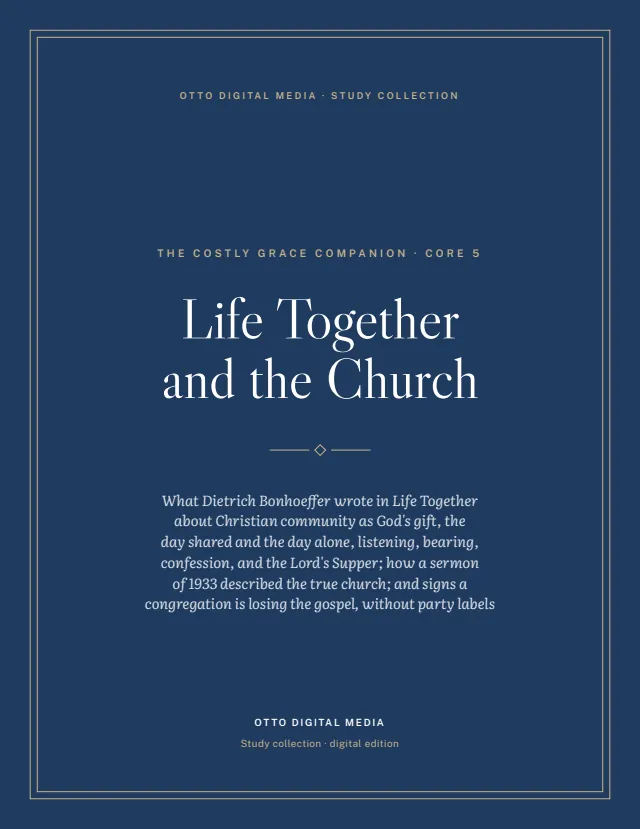
Core 540 pages
Community as God's gift, the day together and alone, listening and bearing, confession, the Supper, and the church of Peter
Look inside
Tap an image to see it larger.
Swipe to see more pages →
The difference
Proof of rigor
Bonhoeffer is quoted from named English editions of his books, letters, and sermons, beside scholarship from Oxford University Press, Knopf, and InterVarsity Press, and the United States Holocaust Memorial Museum. Every quotation was checked word for word by script before each build.
"Silence in the face of evil is itself evil" has not been found in Bonhoeffer's writings.
Bonhoeffer was not arrested for the plots against Hitler; the charges included conspiring to rescue Jews.
The Barmen Declaration did not mention the Jews or the Aryan paragraph.
In the letters on "religionless Christianity," Bonhoeffer kept daily Bible reading, hymns, and a "secret discipline."
Honestly
Before you decide
This kit reads it with the prison letters, Life Together, Act and Being, and his sermons, and shows what he later said about the book's dangers.
Every item begins with a short answer in plain English, and the glossary defines 48 terms with their most common misuse.
The videos raise questions. The kit is the reference work: the source for every claim and the exact page when you need it.
Neither. It quotes Bonhoeffer and the scholars on several sides, reports their disagreements, and names no present-day party as Nazi.
Some evangelical critics say so. Core 1 reports them and their answerers, and every chapter shows what he wrote so you can judge.
No. Ethics is not quoted; the kit says so and relies on the books and letters it could verify.
You have 7 days to ask Hotmart for a refund, as set out below.
Guarantee
If the kit isn’t right for you, ask for a refund within 7 days of purchase and you get 100% of your money back, even if you’ve already downloaded the PDFs. No reason needed.
Request it on Hotmart under My Purchases, or email contact@ottodigitalmedia.com. Read the Refund Policy
Your complete Companion
Open the index, find your situation, read the answer, and tap the reference: you land on the page with the full discussion and its sources. If you prefer to read in order, the workbook's diagnostic suggests a path.
Everything you get
Digital product in PDF. An independent study kit, not an edition of Bonhoeffer's works.
7-day money-back guarantee · Payment processed by Hotmart
Frequently asked questions
Thirteen PDF pieces in US Letter size (the visual pieces in landscape, also as images) and a complete edition that brings them together in one 275-page PDF.
Yes. It is a US Letter PDF, and the workbook's lines are meant for notes on paper or on a tablet.
The Cost of Discipleship (trans. R. H. Fuller, rev. Irmgard Booth), Letters and Papers from Prison (Enlarged Edition), Life Together (trans. John W. Doberstein), Act and Being (Dietrich Bonhoeffer Works, vol. 2), and The Collected Sermons (ed. Isabel Best), in brief quotations.
No. It is an independent work, not affiliated with or endorsed by the International Bonhoeffer Society, the Dietrich Bonhoeffer Works editorial board, Fortress Press, SCM Press, or any institution devoted to Bonhoeffer.
No. It reports what Bonhoeffer wrote and what historians document, labels scholars' political judgments as theirs, and never equates a present-day party with the Nazis.
Core 3 reports a scholarly review that calls the film "sincere but problematic," and checks the claim that he was an assassin.
As soon as your payment is confirmed, Hotmart emails you access to download the PDFs. They also stay in My Purchases in your Hotmart account.
You have 7 days from purchase to ask for a full refund, with no reason needed, even if you’ve already downloaded the files. Ask on Hotmart or by email; the details are in the Refund Policy.
Email contact@ottodigitalmedia.com from the address you used to buy. We reply by email.
His own words, the scholars' debates, and the myths checked, in 13 pieces.
Get the Companion — $49.90Navigable PDF · 13 pieces · 271 pages